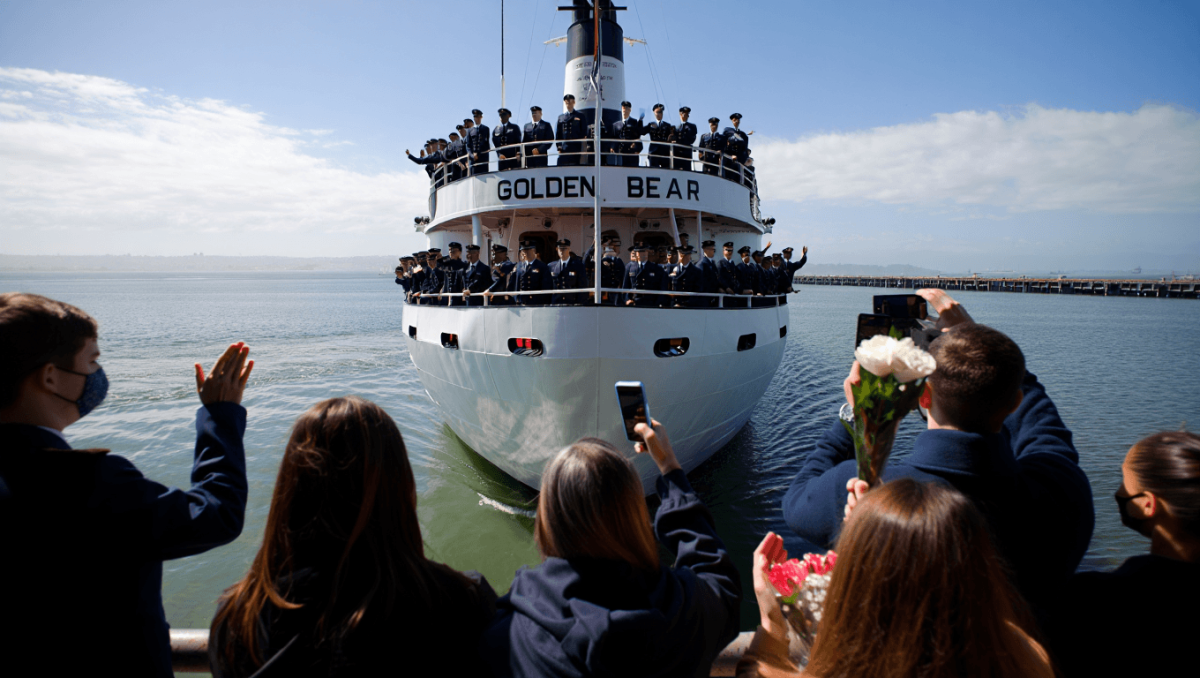
When the Training Ship Golden Bear cast off from Vallejo on May 8, it carried more than a summer class of students — it began what officials call the vessel’s final major training cruise before a scheduled replacement in 2026. For more than 300 cadets from Cal Poly Maritime Academy, the departure launched a demanding 65-day Pacific program that blends hands-on seamanship with formal certification work.
For three decades the 500-foot vessel has acted as a mobile campus, and this summer’s voyage arrives at a crossroads: the last extended deployment of a longtime training platform and the first Summer Sea Term since Cal Poly Maritime formally joined Cal Poly.
Cadets lined the rail as the ship slipped its moorings, a familiar scene that officials and alumni say reflects the academy’s culture as much as its curriculum. “Golden Bear has always been central to how we teach and who we are,” said Captain Samar Bannister, who first sailed on the ship as a freshman decades ago. “For many students, the sea is where their careers begin.”
Christa Pike released from hospital after failed execution, attorneys say
Dolly Parton tribute drives Madonna Inn crowds: steakhouse unveils limited menu
The itinerary spans the northeastern Pacific and several Pacific island ports, with scheduled calls in San Diego; Papeete, Tahiti; Suva, Fiji; and Honolulu. The voyage combines navigational watches, engineering duties and classroom lessons delivered aboard six onboard classrooms that double as practical labs.
Crew responsibilities are continuous. Cadets rotate through core assignments that simulate life at sea: engine-room watches monitoring machinery, bridge watches focused on navigation and collision avoidance, and rounds of maintenance and inspection work. Students also complete U.S. Coast Guard assessments required for international service.
Why this matters now: the voyage caps a long-running training model while preparing a generation of mariners to step aboard a new, purpose-built training ship — the Training Ship Golden State — set to replace the Golden Bear at the end of 2026. The change signals an update to facilities and teaching platforms, but it also marks the end of an era for many alumni and instructors.
Marine transportation senior Katin Chomchavalit is among the roughly 300 cadets on board. His mother, Melanie Chomchavalit, said watching him depart was a proud and emotional moment. “It’s a tough, respected path he’s chosen,” she said. “You feel proud, and you also realize he’s heading into a life that will take him far from home.”
- Departure: Vallejo, May 8
- Duration: 65 days of at-sea training
- Cadets on board: More than 300 first- and third-year students
- Ports of call: San Diego; Papeete (Tahiti); Suva (Fiji); Honolulu
- Training focus: engine-room watches, bridge navigation, classroom instruction, U.S. Coast Guard assessments, maintenance and repairs
- Transition: TS Golden Bear to be replaced by Training Ship Golden State at end of 2026
Cadets typically work seven days a week during Summer Sea Term, with schedules designed to replicate commercial shipboard life. Instructors say the intensity is deliberate: students must prove proficiency under continuous operational conditions to qualify for officer roles ashore and at sea.
Bannister recalled her own early cruise as a pivotal moment. Some cadets discover a lifelong vocation at sea; others use the experience to redirect their studies. Both outcomes, she said, are valuable training results.
The Golden Bear is due back in California in July, completing what academy leaders describe as an important bridge between past tradition and the academy’s next chapter of training aboard a modern, dedicated platform.