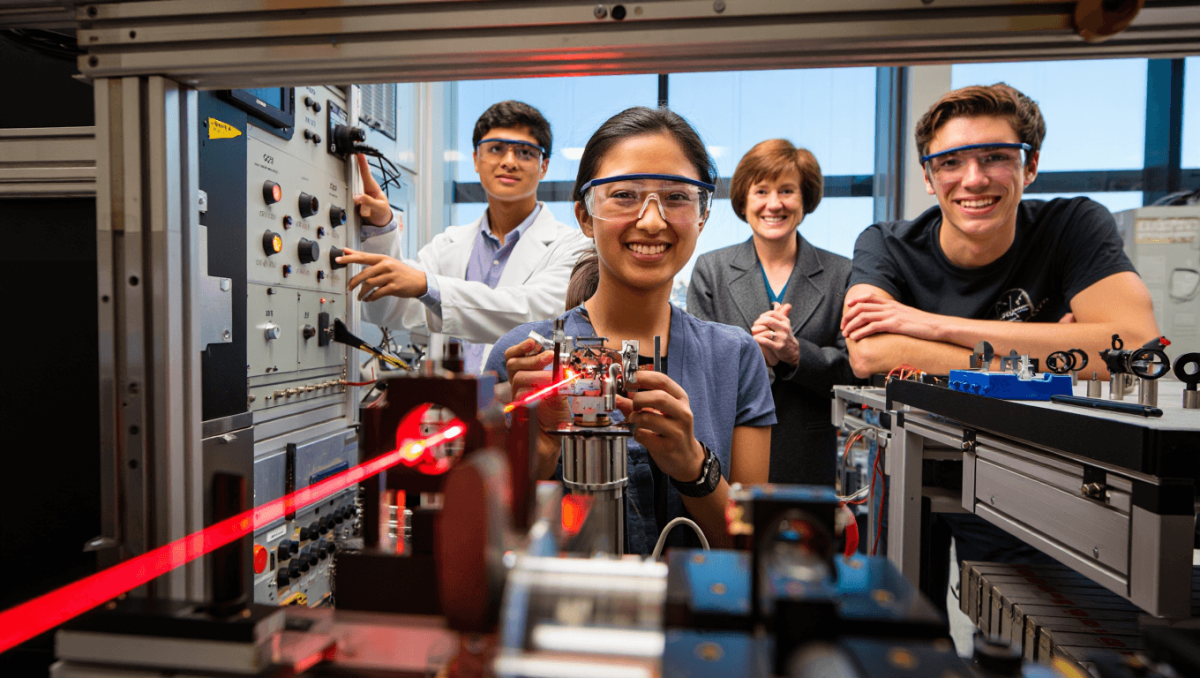
Cal Poly’s Photon Lab this year completed an in-house laser system, giving students hands-on experience with advanced optics and positioning the university to compete for larger research grants. The project, led by assistant professor Isinsu Toker and built by two students, moves Cal Poly from teaching optics to producing it — with presentations planned at major conferences later this year.
The device is built around a titanium‑sapphire gain medium and can run as a continuous-wave source or produce ultrafast bursts known as femtosecond pulses — flashes that last about one quadrillionth of a second. Although similar lasers are commercially available, assembling one on campus required sourcing parts, precise alignment and iterative troubleshooting.
Construction began after the team ordered components and received a donated pump laser from physics professor John Sharpe. Work stretched across the winter and spring quarters as the students adjusted mirrors and crystals to exact tolerances; when the beam behavior did not match expectations, they routinely dismantled and rebuilt optical sections to refine the alignment.
Christa Pike released from hospital after failed execution, attorneys say
Dolly Parton tribute drives Madonna Inn crowds: steakhouse unveils limited menu
For senior Hannah Bauer the project served as a capstone to her undergraduate studies and sparked a commitment to pursue graduate training in optical engineering. Freshman James Mauck joined as a co‑researcher and described the experience as a rare opportunity early in his academic career that has already expanded his prospects for future research.
Assistant professor Toker framed the accomplishment as foundational rather than revolutionary: the lab now houses a new technical capability that will support broader, campus‑wide collaborations and make Cal Poly more competitive for external funding. The Photon Lab’s team plans to submit results to Optica and will present at SPIE Optics + Photonics 2026 in August.
Why this matters now
The project matters beyond campus because hands‑on laser construction trains students in skills that industry and research labs seek, while creating locally available experimental infrastructure. That combination can accelerate regional partnerships and bring additional grant money to Cal Poly.
- Education: Undergraduates gain practical optics experience rarely available at the classroom level.
- Research capacity: An in‑house ultrafast laser enables new spectroscopic and materials studies.
- Funding leverage: Demonstrated technical capability strengthens proposals for external grants.
- Cross‑disciplinary use: Labs across biology, engineering and chemistry can apply the laser to diverse experiments.
Students described key moments of satisfaction: first seeing a stable beam and then generating the femtosecond pulse train — phenomena that are invisible to the naked eye but central to ultrafast optics. Those milestones reflect months of meticulous work calibrating optics and electronics.
The Photon Lab is positioning itself as a shared facility. Toker emphasized that lasers are inherently interdisciplinary tools; campus researchers in fields ranging from spectroscopy to imaging could find new experimental possibilities now that the system is operational.
Looking ahead, the team expects to present their methods and initial data at Cal Poly’s fall research symposium, followed by the international SPIE meeting in August. Their immediate goals include refining pulse characteristics, documenting system stability, and inviting collaborators from other departments to propose experiments that leverage the new capability.
For the students involved, the experience has already changed career trajectories: one plans graduate study in optics, the other aims to remain engaged with laser development while completing his undergraduate degree. The lab’s incremental step — building a laser on campus — is therefore both a training ground and a platform for expanding Cal Poly’s research footprint.