Show summary Hide summary
A single case of the long-vanished New World screwworm found in Texas this week has renewed concerns across the southern Plains, lifting the specter of an insect that can devastate livestock and ripple through regional beef markets. Officials say rapid containment efforts are under way, but ranchers and animal health agencies are watching closely to prevent spread into Oklahoma’s large cattle industry.
What the pest does and why it matters now
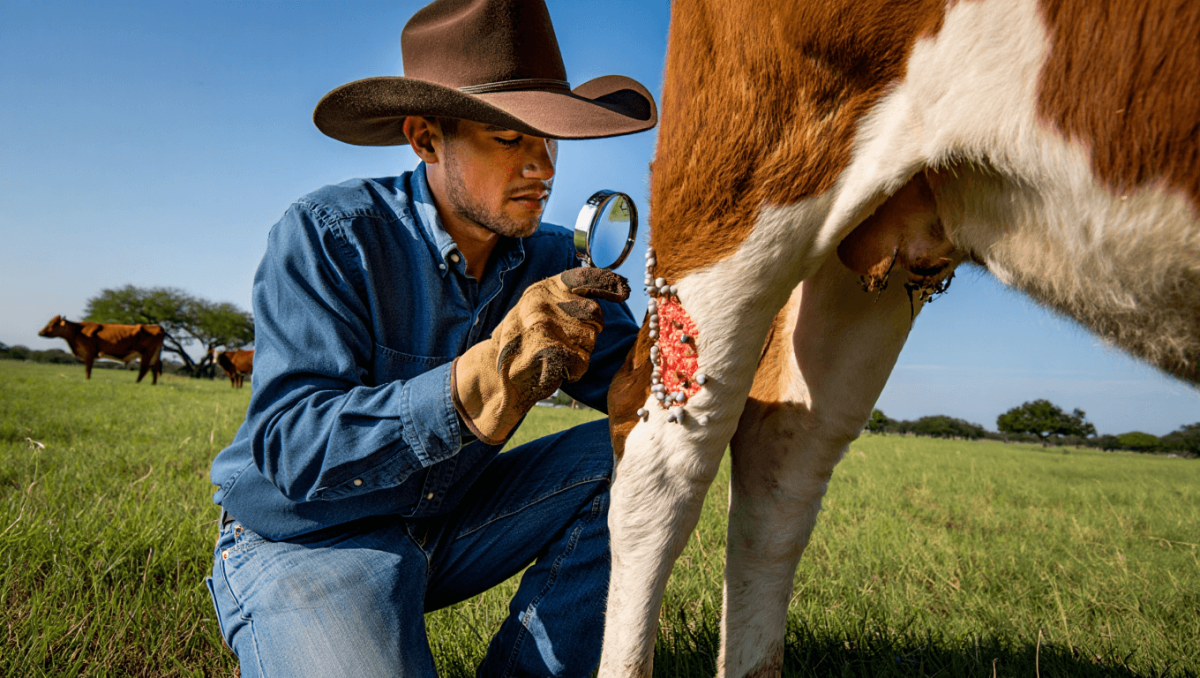
The New World screwworm is a parasitic fly whose larvae feed on living tissue, burrowing into wounds and causing severe damage. While the adult fly resembles other common flies, it is the maggots — often visible as cream-colored larvae in a wound — that create the medical and economic problems for animals and, in rare cases, humans.
Left unaddressed, infestations can lead to secondary infections and, ultimately, death. For livestock owners, that translates to lost animals, higher veterinary costs and disruption to herd health — which is why a single confirmed case near San Antonio has drawn immediate federal and state responses.
Christa Pike released from hospital after failed execution, attorneys say
Dolly Parton tribute drives Madonna Inn crowds: steakhouse unveils limited menu
How the insect was previously controlled — and why officials are revisiting the strategy
Mid-20th-century eradication in the United States was achieved through the release of sterilized male flies, a method known as the sterile insect technique. Males were mass-bred, sterilized with radiation and released; matings with wild females produced no offspring, collapsing local populations. That campaign eliminated the pest from the U.S. by 1966 and pushed it south through Central America over subsequent decades.
But screwworm reappeared in southern Mexico in 2024 and moved closer to the border in 2025. On June 3, 2026, the U.S. Department of Agriculture confirmed larvae were recovered from the umbilical area of a newborn calf in Zavala County, Texas. That is the only reported case so far, federal officials say.
Immediate containment and surveillance steps
Federal and state agencies are mobilizing familiar tactics used in past eradication efforts and adapting them to current conditions: personnel are being deployed to the affected area, a quarantine and surveillance perimeter of roughly 20 kilometers has been established around the detection site, and the expedited release of sterile males is being pursued to interrupt breeding.
Veterinary teams are also conducting targeted inspections of herds, testing suspect wounds, and coordinating communication with livestock producers across neighboring counties and states.
Potential economic consequences
Analysts warn that a widespread outbreak would carry heavy costs. A 2024 economic assessment by the Animal and Plant Health Inspection Service estimated that an outbreak affecting more than one million head of cattle in Texas could reduce economic output by about $1.8 billion. Those losses would come from decreased production, treatment expenses and market disruptions.
For Oklahoma — whose cattle sector is among the nation’s largest — the risks are practical as well as financial. The state reported substantial beef and veal exports in recent years and an industry that contributes billions to the local economy, making early detection and rapid response a priority for animal health authorities there.
What producers, pet owners and wildlife handlers should do now
- Inspect animals frequently — check newborn navels, castration and dehorning sites, tick bites and any open wounds.
- Look for key signs: unusual enlargement of a wound, foul-smelling discharge, and visible larvae or maggots in tissue.
- Isolate animals with suspicious wounds and seek veterinary evaluation immediately to reduce spread and prevent severe injury.
- Report suspected cases without delay to a veterinarian, local extension agent, or the state animal health office. In Oklahoma, the ODAFF State Veterinarian can be reached at 405-522-6141.
No confirmed detections have been reported in Oklahoma. Still, the state department of agriculture has urged producers, pet owners, wildlife rehabilitators and hunters to remain vigilant and to report any unusual wounds or suspected infestations promptly.
The current response aims to stamp out this single detection before it can establish a local population. If successful, it would mirror past eradication campaigns; if not, the region could face a costly, protracted effort to protect herds and restore trade confidence. Either outcome hinges on quick detection, coordinated agency action and cooperation from livestock owners on the ground.
Reporter note: Information in this article is based on statements from the U.S. Department of Agriculture and state agriculture officials.