Show summary Hide summary
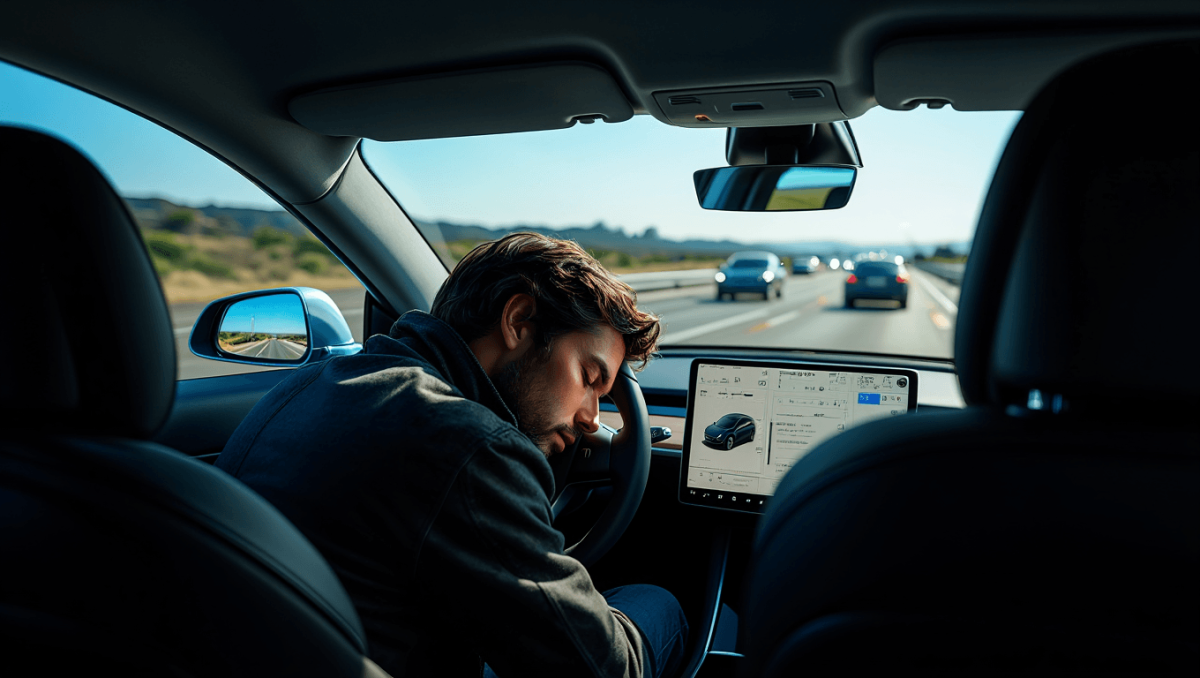
A short video circulating online shows a Tesla driver apparently asleep behind the wheel on southbound I‑5 in Southern California, and the clip cuts off while the driver is still unconsciously slumped in the seat. The footage has renewed debate over the limits of driver-assist systems and the responsibilities of motorists using them on busy highways.
What the video appears to show
Shared across social platforms, the recording — taken from inside the vehicle — depicts a person with their head tilted and eyes closed while the car continues along the interstate. The footage ends before the person visibly regains alertness, leaving several details unclear: whether any driver-assist feature was active, how long the driver had been drowsing, and whether other road users were endangered during the interval.
Without corroborating information from law enforcement or the vehicle owner, the clip raises questions rather than providing a full account. Still, it highlights a persistent problem: moments of inattention behind the wheel can have immediate consequences on high-speed roadways.
Christa Pike released from hospital after failed execution, attorneys say
Dolly Parton tribute drives Madonna Inn crowds: steakhouse unveils limited menu
Why this matters now
Advanced driver-assistance systems have become common on newer cars, but regulators and safety researchers repeatedly caution that these technologies do not substitute for an attentive driver. The incident on I‑5 matters because it underscores the tension between automated features and human oversight — a central issue in several recent safety investigations.
For the public, the stakes are practical and legal. States enforce requirements that drivers remain in control of their vehicles; relying on automation without maintaining vigilance can expose a motorist to fines, insurance consequences, and liability if a crash occurs.
- Hands-on requirement: Most systems require drivers to stay engaged and be ready to intervene.
- Driver monitoring: Manufacturers and regulators are increasingly emphasizing cameras and sensors that detect inattention.
- Investigation triggers: Widely shared footage can prompt local police or federal agencies to review an incident.
- Public safety: Even brief lapses at interstate speeds can lead to multi-vehicle collisions.
Experts say that context matters: the presence of lane-keeping or adaptive cruise control might explain why a car stayed centered, but it does not absolve the driver of responsibility. Companies behind these systems advise that motorists must remain alert and be prepared to take over at any moment.
There is no immediate public record indicating charges or a crash tied to this clip. Local authorities typically review such videos when they are forwarded to them, and federal agencies have in past years opened broader probes after related incidents involving automated features.
At a minimum, the footage serves as a reminder that automation can lull drivers into a false sense of security. The recording ends while the driver appears to remain asleep — a gap that leaves unanswered questions about exactly what happened next and whether any enforcement action followed.