Show summary Hide summary
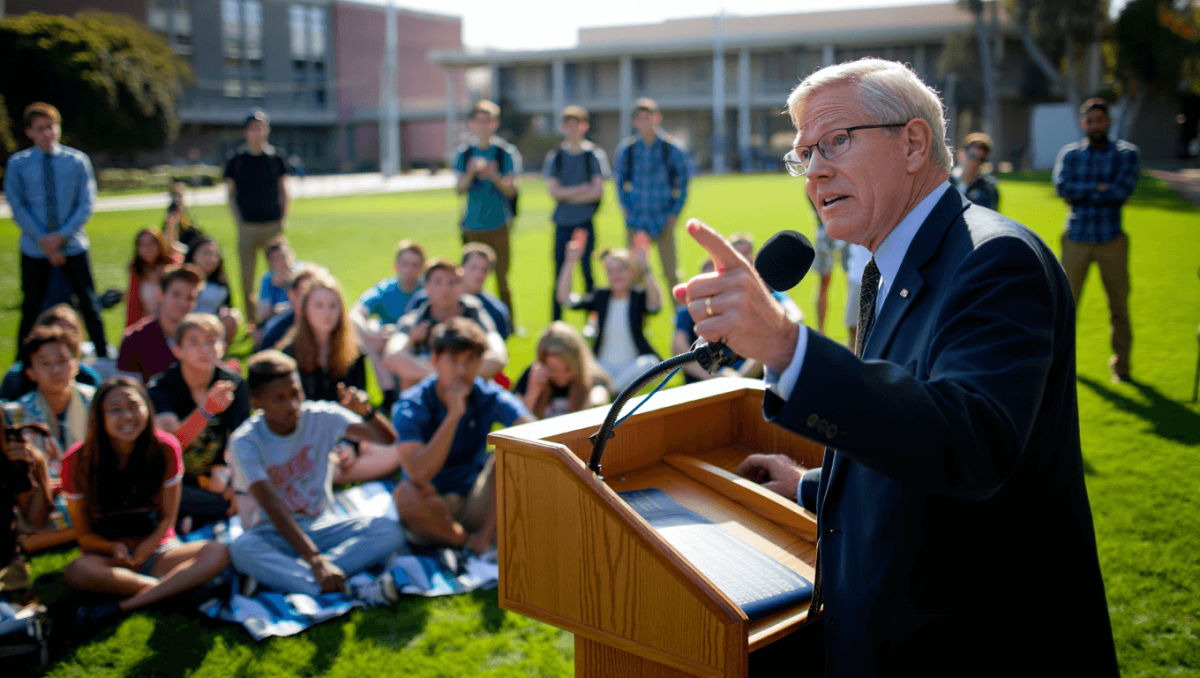
On Wednesday, a four-hour public Q&A on Dexter Lawn drew a steady stream of students as evangelist Ray Comfort and members of Living Waters Ministry answered questions and debated campus attendees in an event organized by the Cal Poly College Republican Club with support from Turning Point USA. Framed under the CSU’s Time, Place and Manner rules, the forum touched on faith, gender and education and was notable for on-site filming and a hovering drone.
The setup resembled last month’s Reawaken USA appearance, but the atmosphere was less vocally confrontational. Organizers said the gathering operated within university policy; campus officials had recently circulated training on freedom of expression to remind students of those guidelines.
Signs around the perimeter made clear the ministry was recording for a separate production, and camera crews moving through the crowd — plus the drone overhead — attracted additional bystanders. Those visual elements appeared to increase curiosity more than outrage.
Christa Pike released from hospital after failed execution, attorneys say
Dolly Parton tribute drives Madonna Inn crowds: steakhouse unveils limited menu
What unfolded at the microphone
Speakers from Living Waters engaged students on theological interpretation and asked direct questions about belief in God, often pressing responses to expose perceived inconsistencies. Topics such as sexuality, gender roles and educational philosophy were repeatedly linked back to scripture during exchanges that ranged from pointed to civil.
Some attendees appreciated the open format. Ruby Davis, a senior studying microbiology, said she stopped to listen because the conversations were intellectually engaging, even if she didn’t side with either viewpoint. Freshman Ellia Suleiman, who is focused on public health, described the event as a useful chance to encounter perspectives she might not otherwise meet on campus.
- Host: Cal Poly College Republican Club, with Turning Point USA assistance
- Speakers: Ray Comfort and members of Living Waters Ministry
- When/Where: Wednesday, Dexter Lawn, roughly 10 a.m.–2 p.m.
- Topics: Biblical interpretation, existence of God, sexuality, gender roles, education
- Notable features: On-site filming, visible signage, drone footage; event held under CSU Time, Place and Manner policy
- Campus reaction: Consistent attendance, mixed responses—ranging from engaged listening to critical disagreement
Oscar Navarro, one of the ministry’s speakers, summarized their intent as twofold: to present their religious message and to invite robust exchange — to challenge students and be challenged in turn. Several students said that balance was visible in practice, while others disagreed about the method.
Jacob Stout, a junior in mechanical engineering who identifies as a Christian, said he evaluates on-campus preaching by how faithfully the message represents the Gospel and that he found parts of the discussion thought-provoking and respectful. By contrast, sophomore nutrition major Josh Hooey argued that faith conversations conducted in an adversarial, debate-like setting can alienate rather than persuade.
There were moments of tension when speakers pursued logical gaps in students’ answers, and some listeners felt that the format favored confrontation. Yet for many who lingered, the event functioned as a live exercise in public discourse — an unpredictable mix of evangelism, academic-style questioning and media spectacle.
Why this matters now
As universities across the country confront competing demands for open expression and community standards, gatherings like this test how policy, media attention and student engagement intersect on campus. The presence of cameras and production crews amplifies that dynamic, raising questions about how recording changes the tone of dialogue and what responsibilities hosts have when filming public forums on university grounds.
Whether one agrees with the views expressed or not, the event illustrated how structured public encounters can shape campus conversation: they surface divisive issues, create teachable moments and force administrators and students to navigate the line between protected speech and respectful exchange.