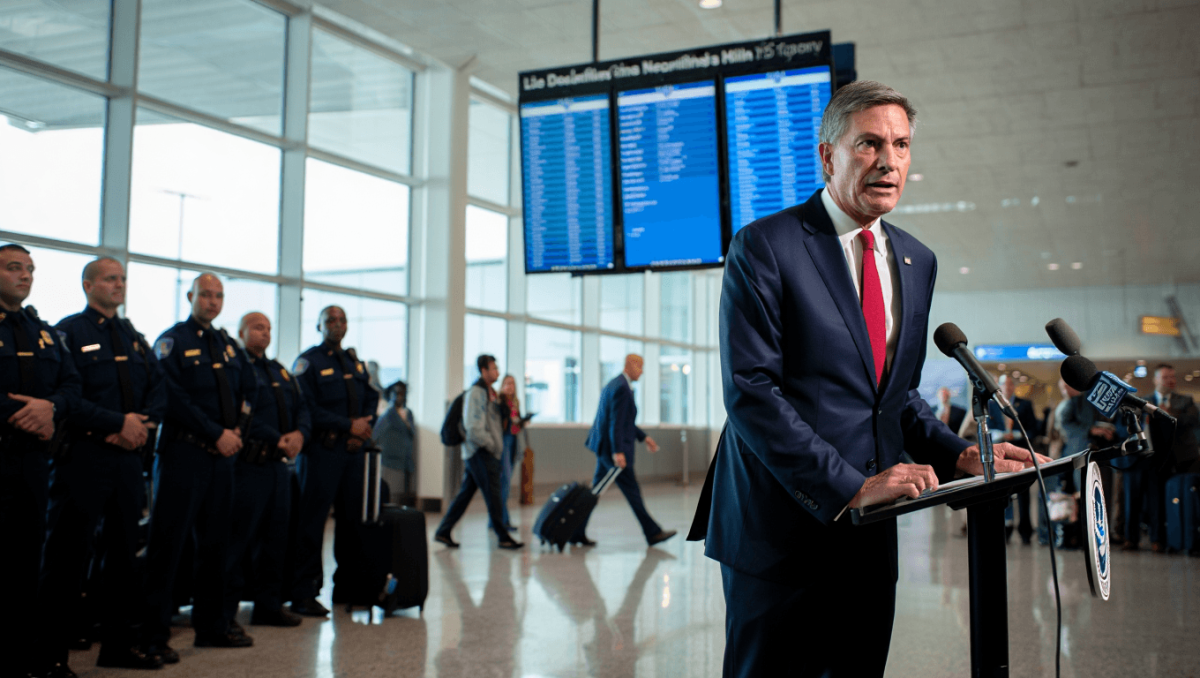
Homeland Security Secretary Markwayne Mullin privately told travel-industry leaders the department could suspend international customs and immigration processing at airports located in cities that decline to cooperate with federal immigration enforcement—a move that, if enacted, would reshape summer travel and freight flows at major U.S. hubs.
People briefed on the conversations said Mullin made the warning in recent meetings after publicly raising the threat during a budget fight in April. The comments underscore a widening clash between the Biden-era state and local policies labeled as sanctuary cities and the federal government’s efforts to tighten immigration controls.
Officials said the list of at-risk airports includes major gateways such as Denver, Philadelphia, Chicago, Los Angeles, New York City, Newark, Seattle and San Francisco. The department could, in theory, withhold full customs and immigration processing at those locations, forcing airlines and passengers to reroute through airports that continue to process international arrivals.
Christa Pike released from hospital after failed execution, attorneys say
Dolly Parton tribute drives Madonna Inn crowds: steakhouse unveils limited menu
Mullin, confirmed as DHS secretary in March and a former U.S. senator from Oklahoma, has already used the possibility as leverage in talks over agency funding. Reporters at other outlets have said the department could delay any move until after the FIFA World Cup concludes in July.
DHS declined to comment on the conversations. A senior Transportation Department official told a House committee he was not aware of the secretary’s remarks and did not back the approach. “We shouldn’t shut down air travel in a state that doesn’t agree with our politics,” Transportation Secretary Sean Duffy said at the hearing.
The reaction from industry groups was swift. Airlines for America warned that shrinking customs staffing at major airports would cause “significant operational disruption” for carriers, travelers and the flow of international cargo. U.S. Travel, representing airlines, hotels and rental car companies, urged policies that preserve “the free and efficient flow of legitimate travelers.”
- Operational impacts: Longer delays at remaining international processing centers and sudden rerouting of flights.
- Cargo consequences: Slower customs clearance could create supply-chain bottlenecks and increase freight costs.
- Economic stakes: Tourism and local business revenues tied to international arrivals could suffer immediate losses.
- Legal and logistical hurdles: Shifting processing responsibilities raises regulatory, staffing and infrastructure questions for airports and federal agencies.
For travelers and cargo operators, the prospect is concrete: moving customs functions from one airport to another is not simply administrative. It requires trained personnel, coordination with U.S. Customs and Border Protection, and physical facilities to screen and process people and goods—changes that cannot be implemented overnight without disruption.
New York-area airports alone handled more than 50 million international passengers last year, a reminder of how concentrated cross-border travel is at a small number of U.S. hubs. Any reduction in on-site processing at large metropolitan airports could cascade across domestic and international routes.
Officials familiar with the private meetings stressed that the options discussed were part of a policy playbook rather than an immediate order. Still, the discussion has put airlines, airports and city officials on alert as the peak travel season approaches and global events such as the World Cup could intensify passenger flows.
The standoff highlights a broader question about federal-state relations: how far the federal government can go in using operational levers to press local jurisdictions on immigration cooperation, and what costs such pressure would impose on commerce and ordinary travelers.